
ISSUE 1 | THE CONTRACTOR’S COMPASS
MAY 19, 2026 | THE BASICS OF JOB COSTING
Do You Actually Know Which Jobs Are Making You Money?
Welcome to the first issue of The Contractor's Compass — a newsletter built specifically for General Contractors, Builders, Remodelers, Subcontractors, Plumbers, Electricians, HVAC Companies, Roofing Contractors, and Real Estate Development Firms who are serious about growing to the next level.
In each issue, we'll cut through the financial noise and give you practical, actionable insights built for how construction businesses actually work.
Construction accounting is different. Job costing, WIP, retainage, and cash timing require specialized expertise — and that's exactly what we handle every day.
In this issue, we're diving into one of the most powerful tools in your financial toolkit: job costing. If you've ever finished a project and wondered where the money went, this one's for you.
Job Costing 101: The Financial Foundation Every Contractor Needs
Here's a scenario we see all the time: A roofing contractor finishes a busy season. Revenue is up 20%. But somehow, the bank account tells a different story. Sound familiar?
The culprit is almost always the same — they know their total revenue and their total expenses, but they have no idea which individual jobs drove profit and which ones quietly drained it. That's exactly what job costing is designed to solve.
What Is Job Costing, Exactly?
Job costing is the practice of tracking all costs — labor, materials, subcontractors, equipment, and overhead — for each individual project. Instead of lumping everything together at the company level, you get a profit-and-loss picture for every single job you run.
The goal is simple: compare what you estimated against what you actually spent, so you know exactly where the money went.
The Cost Categories You Need to Track
Every job has direct costs tied specifically to that project — and they need to be tracked carefully. Most contractors know their big numbers, but the details are where margin is won or lost.
Labor — Wages, payroll taxes, workers' comp — all hours tied to the job
Materials — Everything purchased or consumed for this specific project
Subcontractors — Any outside vendors or specialty contractors you bring in
Equipment — Rentals, tools, and machinery used specifically on this job
Estimated vs. Actual: Where the Real Learning Happens
The true power of job costing isn't just knowing what you spent — it's comparing that to what you bid. This is called a job cost variance report, and it's one of the most valuable documents a contractor can review.
Here's a real example — a residential renovation project that looked fine from the outside:
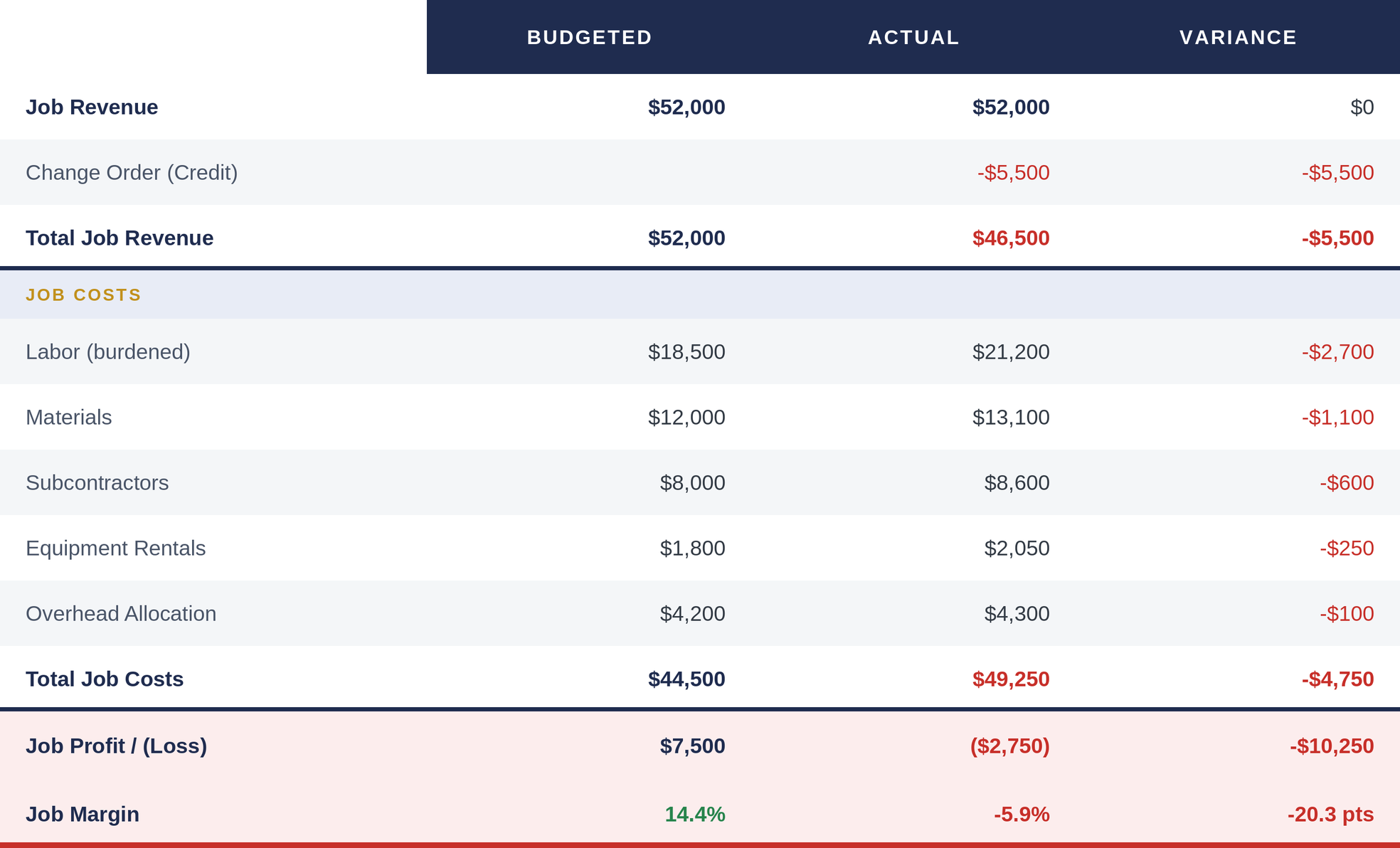
The crew was busy, the customer was happy, and $52,000 in revenue felt solid. But a change order gave back $5,500, labor ran $2,700 over, and materials, subs, and equipment all crept up. Once overhead is allocated, a job budgeted to deliver a 14.4% margin turned into a loss of -5.9% — a swing of over 20 points.
The owner didn't just miss profit on this job. He lost $2,750 doing it. Without job costing, he never would have known until tax season — if even then.
A Note on Burdened Labor
You may notice the labor line says "burdened." This is one of the most overlooked concepts in construction job costing.
You might be paying someone $50/hr — but by the time you add payroll taxes, workers' comp, health insurance, and other benefits, that employee is actually costing you $72–75/hr. If your labor markup is based on the wage rate and not the burden rate, you're underbidding every single job. We'll cover burdened labor in depth in a future issue.
Quick Tips to Get Started
✅ Start Simple — You don't need sophisticated software on day one. Even a basic spreadsheet per job is a massive upgrade over tracking nothing.
✅ Code Every Expense — The moment a bill comes in, assign it to a job. Trying to sort costs at month-end is a recipe for guesswork.
✅ Review Jobs at Close — Schedule a 30-minute job close-out review. Compare estimated vs. actual and write down one lesson learned.
✅ Watch Your Labor Hours — Labor overruns are the #1 margin killer for contractors. Track hours weekly, not after the job is done.
How Odyssey Helps
Odyssey is CPA-led and construction-focused — and that combination matters. Most general accounting firms treat construction like any other industry. We don't. Job costing, WIP reporting, retainage tracking, and construction cash timing are what we do every single day, for businesses just like yours.
We implement job costing within your existing accounting system (QuickBooks, Sage, or others), build custom reporting so you can see profitability by project, and train your team on how to code costs correctly from day one.
Think of us as your outsourced accounting department and fractional CFO — available when you need expert-level financial guidance, without the cost of a full-time controller or CFO hire.
What Success Looks Like
At Odyssey, we believe every construction business owner deserves to know exactly where they stand. Here's what success looks like when you have the right financial foundation in place:
✔ Your numbers make sense. ✔ Your cash is steady. ✔ Your jobs are priced right. ✔ You know when to hire. ✔ You know what you can pull out of the business. ✔ And tax season isn't a surprise.